As we have already seen, we may not be able to attain a solution of a differential equation easily, but rather than drawing a slope field we may desire to obtain numerical estimates for solutions to differential equations instead.
Euler’s Method is a numerical method that uses the idea of tangent lines for a short distance to approximate the solution to an initial-value problem.
Now, from our previous study, we know that the basic idea behind Slope Fields, or Directional Fields, is to find a numerical approximation to a solution of a Differential Equation, but Euler’s Method is a technique where we create a table rather than a graph and can be incredibly accurate.
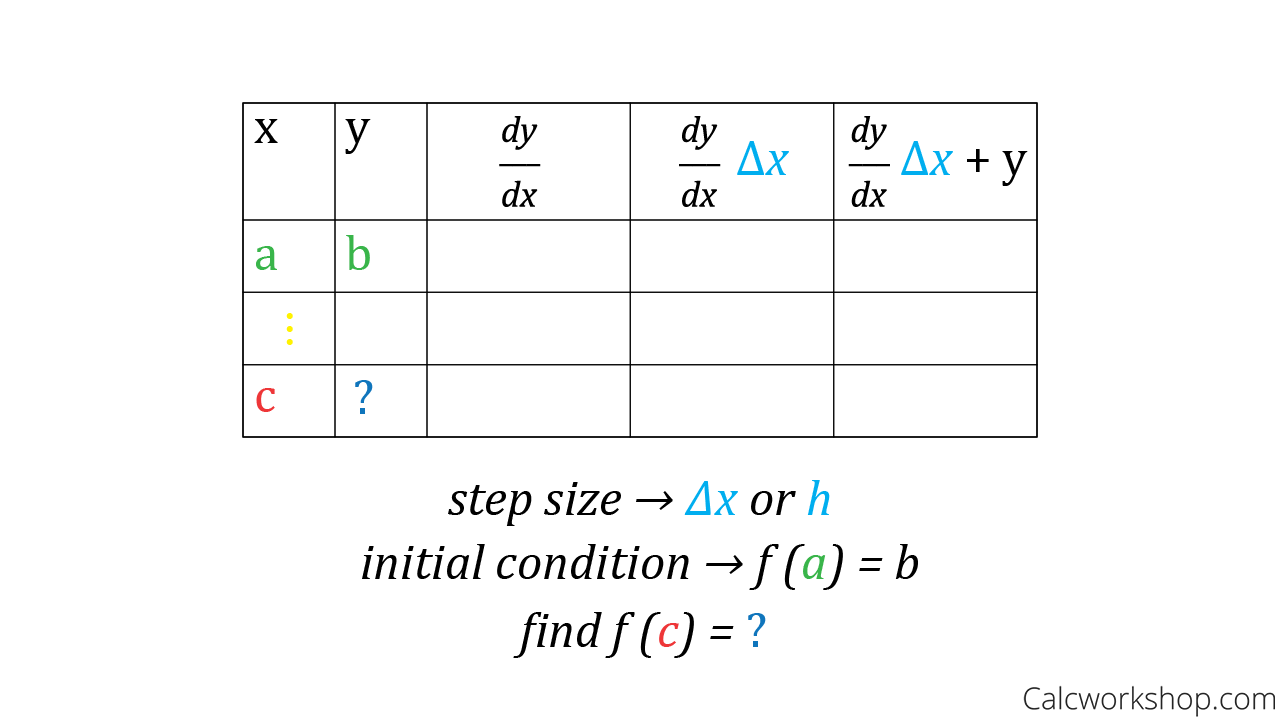
Table for finding Euler’s Approximation
Here’s the big idea…if we zoom in small enough, every curve looks like a straight line, and therefore, the tangent line is a great way for us to calculate what is happening over a period of time.
With this idea, we embark on our study of Euler’s Method. As SOS Math Math nicely states, with this idea that, close to a point, a function and its tangent line do not differ very much, we will obtain numerical approximations to a solution.
We will begin by learning how to create an easy table, for which we will be able to solve any and all questions dealing with Euler’s Method and utilize this table for several examples.
Then we will see how to fill-in, or complete, the table starting with the initial value and proceeding in the direction indicated by the direction field.
Lastly, we will then look a question where we compare our three techniques for Differential Equations: Slope Fields, Euler’s Method, and finding particular solutions via Separable Differential Equations.
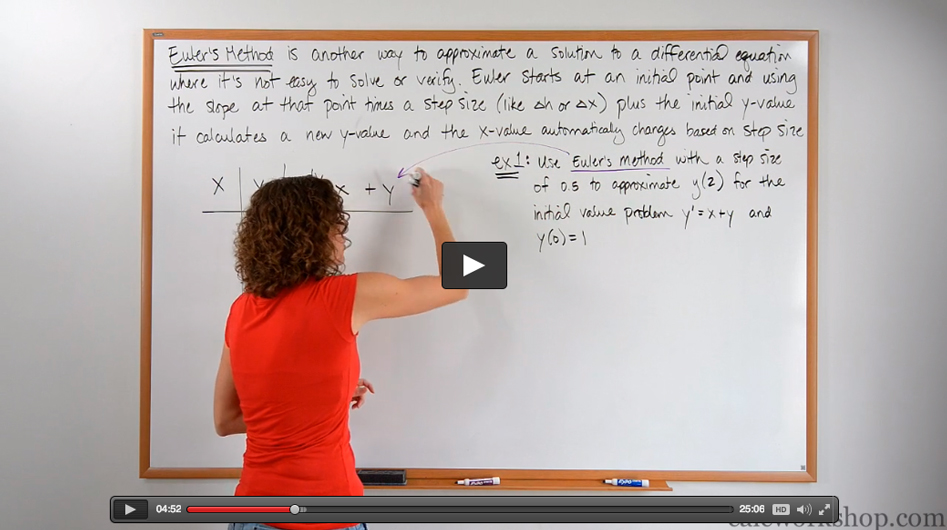
Eulers Method Video
Get access to all the courses and over 450 HD videos with your subscription
Monthly and Yearly Plans Available
Still wondering if CalcWorkshop is right for you?
Take a Tour and find out how a membership can take the struggle out of learning math.
My experience with CalcWorkshop was great. I needed a little tune-up/review of the fundamentals, and the instruction focused on that as well as the main topics that provided the quickest results I was looking for. Overall - outstanding. Will return in the future if needed.
MoreBefore finding CalcWorkshop, I had failed Calculus and genuinely didn't know how to learn the subject. I felt lost and discouraged. After discovering CalcWorkshop and reaching out to Jenn, everything changed. She always responded promptly and took the time to explain concepts in detail, often with long, thoughtful explanations that made things finally click.With her help, I earned an A in both Calculus and Linear Algebra. CalcWorkshop aligns extremely well with what my professors teach in class, so whenever I had to miss a lecture, I could rely on it to catch back up and stay on track. I highly recommend CalcWorkshop to anyone who feels stuck or overwhelmed by math.
MoreI recommend this website to literally anyone who will listen. I went back to school online after over a decade and had never taken calculus before. Calculus 1 was an absolute nightmare. I found calcworkshop from an ad on a YouTube video trying to stumble my way through understanding calculus 2. It was an absolute game changer from the minute I found it. Jenn's program followed my schools curriculum, almost exactly, and she stopped to explain all of the things that my school assumed that I knew, but had either forgotten or never learned them since I graduated high school over a decade before. I went from not understanding anything to getting A's in calc 2, 3, and diff eq. I absolutely could not have done it without this website. Thank you, Jenn!!
MoreCalcWorkshop turned vague, overwhelming concepts into clear, digestible lessons that were easy to understand and apply in practice. I'd recommend it to anyone in need of math support.
MoreGreat videos, easy to understand, and plenty of practice problems. Great website!
MoreIt was the YouTube ads that got me here. I needed more resources for calculus 2 and I realize I thrive off of lecture videos and extra practice problems. It's super difficult to find that structure, but I'm so lucky that I found Calcworkshop. I ended calculus 2 with an A and I will be back for Calculus 3 and differential equations. There's so much concepts in calculus 2 that it's easy to fall behind if you're not fully aware about all of the rules. I love the fact that I was able to learn a concept in 1 to 2 hours and then practice a little bit more and then move onto the next topic. Certain sections like series and sequences kind of built off of each other and so that's why it feels easy to move onto the next technique. Same thing with integration if you generally just master the topics well, they solely buildup off of each other and learning, a new concept won't be so scary and you already know partially how to do it.
MoreJenn's videos were absolutely amazing! They helped me pass my college-level business calculus course-I truly could not have done it without Calcworkshop. Jenn explains complex topics so clearly and breaks everything down step-by-step in a concise, easy-to-understand way.Beyond the excellent content, the customer support was phenomenal. Jenn allowed me to email her directly and took the time to look through my syllabus and weekly topics, pointing me toward the exact videos I needed for my coursework. What a Grade-A experience! I highly recommend Calcworkshop to anyone about to start a math course, especially non-traditional students returning to mathematics after a long time away. Thank you again!
MoreI went back to college at 43, for a degree in engineering. I never went above basic trigonometry in high school, so when I got to calculus I was lost. CalcWorkshop helped me through Calculus 1, 2, and 3, as well as differential equations and linear algebra. Jenn teaches in a step by step manner that is easy to learn and use. I would recommend CalcWorkshop to anyone struggling in math or just wanting it explained in an easier way to clarify things that maybe are skipped over or rushed through in school. It was a great experience! I just graduated at 47 with my engineering degree, Jenn and CalcWorkshop helped me make it through! Thank you!
MoreMy overall experience with CalcWorkshop has been very positive. The lessons are explained in a clear, step-by-step way that makes difficult calculus concepts much easier to understand. I especially liked how the instructor breaks problems down slowly and explains the 'why' behind each step instead of just memorizing formulas.
MoreMy experience with calcworkshop was beyond amazing. Jen's teaching style is how I learn math the best. She takes every problem and breaks it down perfectly showing you how to solve it step by step. Her notes on the board are easy to follow and all of her videos are clear and engaging. Also, the price per month is super affordable. Calcworkshop is officially in my tool box. I highly recommend it, don't think twice about it. It truly saved my grade and it can save yours too. Thank you, Jen.
MoreLoved the over all course and demonstration of techniques. Although in the classes I was taking there wasent always a video regarding the topic covers. However, I passed so... over all great help and would recommend to someone who is also in the same boat!
MoreUsed site to help tutor college grandson who had a C at midterm and ended up with an A for the term. Excellent resource. Jenn is a great teacher.
MoreI am a retired math teacher who wanted to "retake" Calc 3 since it had been so long since I've had the course. I still love working math problems and I still tutor students. The course is extremely well laid out, and Jenn's explanations are very clear. She knows the subject well and is clearly passionate about teaching it to others. I am going to take at least two more courses through this website. I have suggested calcworkhshop to other friends of mine that still want to do math and to some students who need help. I've seen other websites and courses, but this one is by far the best!
MoreCalcworkshop is so helpful, it saved my calc3 grades!
Saved my grade!! So many examples and details that my professor did not go over, would not have made an A without this program!
MoreThis course honestly made a huge difference for me. As an online student, I struggled throughout my calculus courses trying to make sense of the video lectures posted by my professors. The explanations were often overly technical and focused heavily on symbolic manipulation without clearly explaining the meaning behind the concepts. For example, professors would rename variables or change notation without helping students understand what those variables actually represented or why those changes were necessary in the first place.Jenn does an amazing job of breaking down difficult concepts into simple, understandable steps. She cuts through the unnecessary complexity and focuses on what truly matters: understanding the process and learning how to solve problems confidently. Her lessons include plenty of practice, clear explanations, and methods that actually make sense.I 100% recommend her courses. They are absolutely worth it. Her teaching style not only helps you succeed on exams, but also helps you genuinely understand the material and build skills you can use in future courses and your career. I honestly wish she had been my college professor.
MoreI wholeheartedly want to thank you Jenn for this useful tool. It helped me succeed and quite honestly just pass my Calculus 1 course as well as my Math Foundations of Computer Science (Discreet Math). Thank you very much again it is an extrodinary platform and I'm sure has helped countless numbers of people just like me. Thank you!
MoreLove it! Very clear and easy to understand explanations and formatting! This course is definitely saving my calc 1 grade!
MoreI feel very happy with the content. I think signing up for this course was the best decision I could have made. Thank you for creating this kind of content-mathematics is truly wonderful
MoreI'm currently taking calculus and linear algebra at university, but I've been struggling to fully understand the material. I used to rely on free YouTube lectures, but I recently came across this site through an online recommendation, and it was truly an eye-opener.The explanations are incredibly clear and well-structured, which has helped me avoid wasting time on misunderstandings and study much more efficiently. I feel like my foundation is finally becoming solid.I'm genuinely grateful to Jenn for such amazing teaching.
MoreGreat compliment to taking math courses in an on-line degree program. Couldn't have gotten through those courses without the Calcworkshop.
MoreCalcworkshop is great! Watching Jenn's videos is the only reason I was able to pass my college classes. I would definitely recommend it to someone else.
MoreEspecially in high school, I cannot recommend these services enough. Not only did I have a much deeper understanding of how the math functions, but I also felt a level of confidence that cannot be understated. Jenn makes everything extremely clear, and uses all kinds of examples that cover all the sorts of problems one may encounter in a topic. Nothing is skipped or assumed, and Jenn makes everything extremely engaging and clear. I would use this service again and again and again.
MoreVery good learning resources no complaints. I will rejoin again in the future.
MoreAmazing !
I enjoyed the lectures and the text lessons on the website. Everything is organized very well and I could go straight to the subject matter I needed a boost with very easily. My only suggestion is to provide more practice problems for those of us who are not taking formal math classes with a text book but are 'non-traditional' students re-sharpening career skills requiring math tools.
MoreI genuinely did not think I would be able to understand my Calc 2 class without your help. Your videos on integration were the only way I could understand through examples that don't skip the calculating parts
MoreThis is an awesome resource to better understand the math concepts that my teacher went over quickly in class. I loved this and would highly recommend!
MoreJenn demystifies the monolith of mathematics as she instills confidence through her meticulous attention to lesson details.
MoreI love the website and how everything is set up. I've always struggled with math as a kid and it's helped me improve drastically as a college student. I always recommend this website to anyone who is pursuing a STEM major/career, because Jen is amazing at explaining all the steps for each subject. I highly recommend this website to anyone who struggles with math, or even if you want to refresh your skills!!
MoreI am using it for self-teaching. It covers a lot of content and is pretty granular. I think it would be a great resource for anybody looking to better their own math skills.
MoreCalcWorkshop has been a game changer for me. Mrs. Jenn explains every step clearly and in a way that actually makes the material make sense. If you are taking calculus online and feel like your professor is moving too fast or not explaining things in enough detail, do not wait to get CalcWorkshop.She breaks down every section thoroughly and provides a ton of examples so you can really understand the concepts instead of just memorizing formulas. On top of that, she includes worksheets and full solutions so you can practice and check your work.What really impressed me was the level of support. If you send her your syllabus, she will help you plan which videos to watch so it lines up with your class. I emailed my syllabus at 8:30 p.m. and had a response by 6 a.m. Monday morning.If you are struggling with calculus or just want a better explanation than what you are getting in class, CalcWorkshop is absolutely worth it.Thank you, Mrs. Jenn!
MoreA very good review of the basics, and I clarified and learned a few things, in the Basics, things I thought I knew about.
MoreThis has given me more confidence in my skills, helped me to understand concepts and then apply them for my course
MoreI love this site, I am passing Calc 1 after failing two others times. I wish I would've gotten this sooner to be honest. I have recommended it to every person I know who is also struggling.
MoreMath was always a struggle for me. Calcworkshops videos, practice problems, and practice tests helped a lot. The videos made complex concepts easy to understand and helped me get through calculus two and three. I would recommend this site to anyone struggling with math at any level.
MoreIt helped me for someone that needed to brush up on my calculus skills. I hadn't taken any math classes for years. So, I forgot a lot of what I learned in business calculus and pre calculus. I started before my semester and worked through many chapters and now I am ready for calculus 2.
MoreThe videos on Calculus, Linear Algebra and Statistics are amazing!!! The explanations in the examples are really good!!!
MoreJenn is nothing short of a life saver. Thank you for all the detailed videos, you have saved my grade and sanity while working through my semester of precalc & Trig.
MoreI am so happy I subscribed to this website. Professor Jenn is amazing at explaining complicated concepts in easy to understand methods. Who thought everything about the unit circle can actually be derived from just the fingers of your left hand and the phrase "All Students Take Calculus"?? Professor Jenn's videos are very thorough and understandable. She goes over the most challenging problems in her videos to set the stage for us to attempt challenging questions. She starts with simple questions and then slowly advance to more difficult ones. I highly recommend Jenn if you want Math of all levels to be very less tedious and complicated. And one of the greatest things is that the subscription is very affordable (very) compared to getting a private tutor.
MoreJust getting started with calcworkshop. The classes taken so far have been excellent and are highly recommended for anyone wanting to improve their math skills.
MoreIt was amazing, knowledgeable easy format Great content.
MoreAs a calculus student, I found CalWorkshop extremely helpful. The lessons break down complex ideas into manageable steps, which made a big difference in my understanding. It's a great supplement to lectures and textbooks, especially when instructors move too fast.
MoreCalcworkshop is exceptional. Available online 24/7, I am able to access the website and study anytime free time presents itself. Thank you, Jenn!
MoreFound a small mistake in the course notes: In the line integral course for question F(x,y) = (x^2, -xy), dx/dt should be -sin(x) not -cos(x).I like the courses, it is really clear and helpful.
MoreEasy to follow explanations and examples
I'm an older student and was interested in completing the calculus sequence at Indiana University. I wanted to review trigonometry so I took a trig course at IU and decided to use calcworkshop to buttress and enhance what I was learning in my college trig course. Wow! Jenn's approach to teaching is amazing because she recognizes where in the course of study (e.g., trigonometry, algebra, calculus, etc.) students become "tripped up," and she then presents algorithms to help students through tricky concepts (e.g., trig identities, memorizing values [trig functions, angle] on the unit circle, mapping functions, etc.). These algorithms are time-savers and help the student navigate complex mathematical waters without "watering down" the rigor of the mathematics. Jenn shows a true love of math, she just does. She is so easy to understand and readily available for questions. Her approach and lessons are so worth it! Thank you Jenn and calcworkshop! Five stars.
MoreHands down the best math teacher I've ever had, your garunteed to understand concepts with her.
MoreI loved it. It feels almost like cheating but it's not. You learn all the concepts in an easy to understand manner.
MoreThank you, Jenn!
My experience with CalcWorkshop was great. I needed a little tune-up/review of the fundamentals, and the instruction focused on that as well as the main topics that provided the quickest results I was looking for. Overall - outstanding. Will return in the future if needed.
MoreBefore finding CalcWorkshop, I had failed Calculus and genuinely didn't know how to learn the subject. I felt lost and discouraged. After discovering CalcWorkshop and reaching out to Jenn, everything changed. She always responded promptly and took the time to explain concepts in detail, often with long, thoughtful explanations that made things finally click.With her help, I earned an A in both Calculus and Linear Algebra. CalcWorkshop aligns extremely well with what my professors teach in class, so whenever I had to miss a lecture, I could rely on it to catch back up and stay on track. I highly recommend CalcWorkshop to anyone who feels stuck or overwhelmed by math.
MoreI recommend this website to literally anyone who will listen. I went back to school online after over a decade and had never taken calculus before. Calculus 1 was an absolute nightmare. I found calcworkshop from an ad on a YouTube video trying to stumble my way through understanding calculus 2. It was an absolute game changer from the minute I found it. Jenn's program followed my schools curriculum, almost exactly, and she stopped to explain all of the things that my school assumed that I knew, but had either forgotten or never learned them since I graduated high school over a decade before. I went from not understanding anything to getting A's in calc 2, 3, and diff eq. I absolutely could not have done it without this website. Thank you, Jenn!!
MoreCalcWorkshop turned vague, overwhelming concepts into clear, digestible lessons that were easy to understand and apply in practice. I'd recommend it to anyone in need of math support.
MoreGreat videos, easy to understand, and plenty of practice problems. Great website!
MoreIt was the YouTube ads that got me here. I needed more resources for calculus 2 and I realize I thrive off of lecture videos and extra practice problems. It's super difficult to find that structure, but I'm so lucky that I found Calcworkshop. I ended calculus 2 with an A and I will be back for Calculus 3 and differential equations. There's so much concepts in calculus 2 that it's easy to fall behind if you're not fully aware about all of the rules. I love the fact that I was able to learn a concept in 1 to 2 hours and then practice a little bit more and then move onto the next topic. Certain sections like series and sequences kind of built off of each other and so that's why it feels easy to move onto the next technique. Same thing with integration if you generally just master the topics well, they solely buildup off of each other and learning, a new concept won't be so scary and you already know partially how to do it.
MoreJenn's videos were absolutely amazing! They helped me pass my college-level business calculus course-I truly could not have done it without Calcworkshop. Jenn explains complex topics so clearly and breaks everything down step-by-step in a concise, easy-to-understand way.Beyond the excellent content, the customer support was phenomenal. Jenn allowed me to email her directly and took the time to look through my syllabus and weekly topics, pointing me toward the exact videos I needed for my coursework. What a Grade-A experience! I highly recommend Calcworkshop to anyone about to start a math course, especially non-traditional students returning to mathematics after a long time away. Thank you again!
MoreI went back to college at 43, for a degree in engineering. I never went above basic trigonometry in high school, so when I got to calculus I was lost. CalcWorkshop helped me through Calculus 1, 2, and 3, as well as differential equations and linear algebra. Jenn teaches in a step by step manner that is easy to learn and use. I would recommend CalcWorkshop to anyone struggling in math or just wanting it explained in an easier way to clarify things that maybe are skipped over or rushed through in school. It was a great experience! I just graduated at 47 with my engineering degree, Jenn and CalcWorkshop helped me make it through! Thank you!
More
 1. What's your gender?